
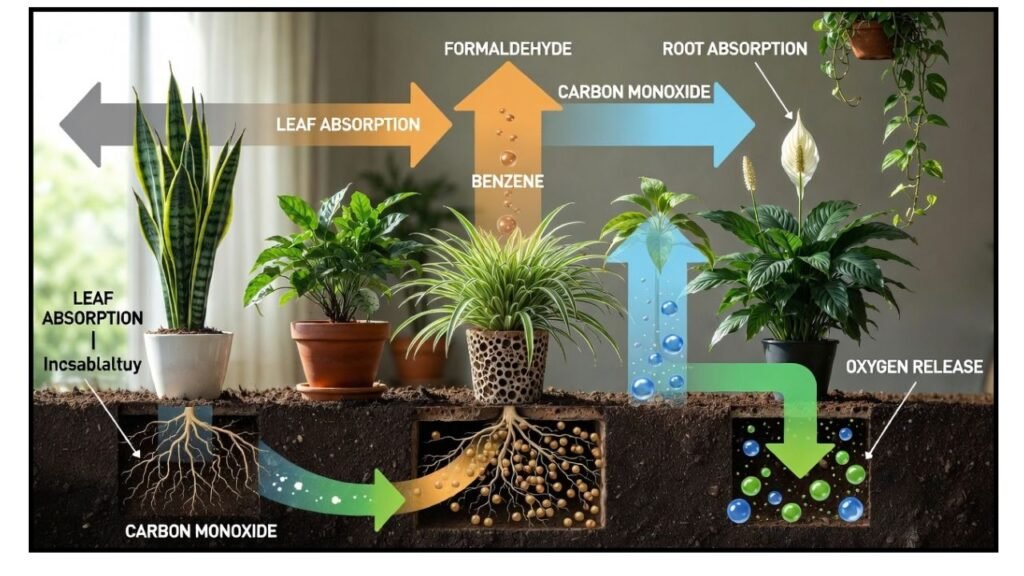
Every day, without realizing it, you’re sharing your home with invisible chemicals. The couch you sit on, the paint on your walls, the cleaning spray under your sink — all of them quietly release toxic compounds into the air you breathe. Most of the time, you can’t smell them. You can’t see them. But they’re there.
The surprising answer to this problem isn’t an expensive filtration system or a complete home overhaul. It’s something far simpler — and far more beautiful. Certain houseplants have a remarkable ability to pull these toxins directly out of the air, breaking them down at a biological level. And the science behind how they do it is genuinely fascinating.
Let’s break it down.
What Toxins Are Actually in Your Indoor Air?
Before understanding how plants remove toxins, it helps to know what you’re actually dealing with. The main offenders are a group of chemicals called volatile organic compounds, or VOCs. These are gases emitted by common household materials and products at room temperature.
The most widespread indoor toxins include:
- Formaldehyde — released by pressed wood furniture, carpets, curtains, and some paper products. It’s one of the most common indoor pollutants and a known irritant to eyes, nose, and throat.
- Benzene — found in paints, glues, solvents, and certain plastics. Long-term exposure has been linked to serious health concerns.
- Trichloroethylene — present in adhesives, varnishes, and dry-cleaned clothing. It enters your home on freshly cleaned garments and evaporates slowly into the air.
- Ammonia — common in cleaning sprays, floor polishes, and fertilizers. Even at low concentrations it causes respiratory irritation.
- Xylene and toluene — released by paints, paint thinners, and printed materials like newspapers and magazines.
The EPA estimates that indoor air can contain two to five times higher concentrations of VOCs than outdoor air. In tightly sealed, modern homes with limited ventilation, that number can be even higher. These aren’t dramatic, immediate health threats in most cases — but chronic low-level exposure over months and years is increasingly linked to headaches, fatigue, respiratory issues, and long-term health risks.
The good news is that plants have been neutralizing toxins in natural environments for millions of years. Bringing them indoors puts that same biological machinery to work in your living room.
The Four Ways Plants Remove Toxins
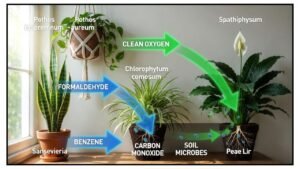
This is where it gets genuinely interesting. Plants don’t just passively sit there looking green — they’re running a sophisticated, multi-layered detoxification process around the clock.
1. Absorption Through the Leaves
The most visible part of the process happens through the leaves. Every plant leaf is covered in tiny pores called stomata, which open and close to regulate gas exchange. When stomata are open — primarily during daylight hours — the plant draws in carbon dioxide for photosynthesis. In doing so, it also pulls in airborne VOCs from the surrounding air.
Once inside the leaf, these compounds are either broken down during metabolic processes or transported down to the root system for further processing. The larger the leaf surface area, the more air the plant can process — which is why large-leafed species like rubber plants and peace lilies tend to be particularly effective.
2. Soil Microbe Activity
This is the most powerful and least talked-about part of the process. The soil surrounding a plant’s roots is home to a dense, thriving community of microorganisms — bacteria and fungi that have co-evolved with plants over millions of years.
When VOCs are absorbed through the leaves and transported to the roots, these microbes get to work breaking the compounds down into simpler, harmless molecules. The plant and its microbial community essentially function as a single detoxification unit — neither is as effective without the other.
This is why soil health matters so much when using plants for air purification. A plant in dead, compacted soil has a significantly diminished capacity to neutralize toxins compared to one in rich, healthy, biologically active soil.
3. Transpiration
As plants absorb water through their roots and release it as vapor through their leaves, they create a gentle air current around them — drawing nearby air toward the leaf surface and through the stomata. This transpiration stream doesn’t just process the air immediately around a leaf; it pulls air from a wider radius into contact with the plant’s filtering surfaces.
Transpiration also raises the humidity of the surrounding air, which has its own purifying effect. Higher humidity causes airborne dust particles and certain pathogens to become heavy enough to settle out of the air rather than remaining suspended where they can be inhaled.
4. Root Absorption
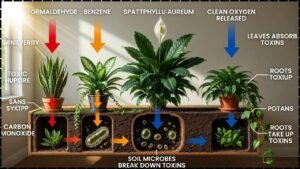
Some VOCs don’t make it to the leaves at all. Research has shown that certain toxic compounds are absorbed directly through the root zone — drawn in through the soil alongside water and nutrients. The roots themselves can metabolize some of these compounds, while others are passed to the microbial community in the surrounding soil for breakdown.
This is one reason why plants in larger pots — with more soil volume and a larger microbial community — tend to be more effective air purifiers than the same species in a small container.
Which Toxins Do Plants Remove Best?
Not every plant tackles every toxin equally. Research — including the original NASA Clean Air Study and numerous follow-up experiments — has identified clear strengths for different species:
Formaldehyde is best absorbed by spider plants, Boston ferns, bamboo palms, and rubber plants. If your home has new furniture, fresh carpets, or recently installed flooring, these are your priority species.
Benzene is most effectively removed by peace lilies, snake plants, and golden pothos. These are smart choices for rooms with painted walls, near garages, or anywhere with adhesives and solvents.
Ammonia is tackled most aggressively by peace lilies and florist’s chrysanthemums — making them ideal for kitchens and bathrooms where cleaning products are used regularly.
Trichloroethylene is best handled by peace lilies, dracaenas, and spider plants. If you regularly bring dry-cleaned clothing into your home, placing one of these species in your bedroom or wardrobe area is a practical step.
Carbon monoxide — less a VOC than a combustion byproduct, but a serious indoor concern — is absorbed effectively by spider plants and golden pothos, particularly valuable near gas stoves and fireplaces.
How to Maximize Your Plants’ Toxin-Removing Ability
Knowing which plants remove toxins is only half the equation. The other half is keeping them healthy enough to do the job properly.
Keep leaves clean. Dusty leaves have partially blocked stomata. Wipe large leaves with a damp cloth monthly and your plant will absorb significantly more from the surrounding air.
Invest in good soil. Since the microbial community in the soil does so much of the actual detoxification work, this is one of the highest-impact things you can do. Use a rich, well-draining potting mix and refresh the top layer annually.
Choose larger pots. More soil volume means a larger, more diverse microbial population — which means more effective toxin breakdown. When in doubt, go up a pot size.
Don’t overwater. Waterlogged, oxygen-deprived soil kills the beneficial microbes your plant depends on. Let soil dry slightly between waterings for most species.
Reduce toxin sources where possible. Plants work harder when they have less to fight. Low-VOC paints, natural cleaning products, and solid wood furniture over pressed particleboard all reduce the chemical load your plants need to process.
Finanaly

Air purifying plants remove toxins through a genuinely elegant biological system — leaf absorption, soil microbe activity, transpiration, and root uptake working together as a continuous, low-maintenance detoxification process.
They won’t replace a good air purifier for allergy or asthma sufferers, and a single pothos won’t undo a poorly ventilated home overnight. But as part of a broader approach to indoor air quality — combined with good ventilation and reduced chemical sources — the right plants in the right rooms make a real, measurable difference