
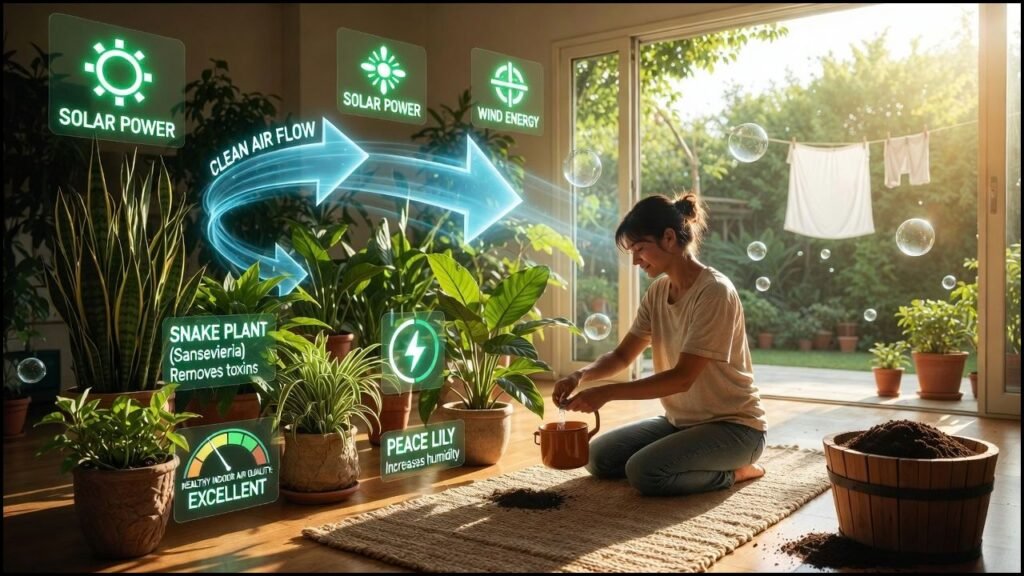
Sustainability has become one of the defining conversations of our time. From the food we eat to the products we buy, more people than ever are looking for ways to live with a lighter footprint — choices that are better for the planet without demanding a complete overhaul of daily life.
But here’s something that rarely makes it into the sustainability conversation: the air inside your home. Most eco-conscious households invest in reusable bags, energy-efficient appliances, and organic food — and then furnish their living rooms with off-gassing sofas and synthetic carpets that silently pollute their indoor air for years.
Air purifying plants address this blind spot in the most natural way possible. They filter toxic chemicals without electricity. They regulate humidity without a humidifier. They improve your mental wellbeing without a subscription. And they do all of it while growing, living, and contributing to the ecosystem around them.
A houseplant isn’t just a decorating choice. For anyone serious about sustainable living, it’s a genuinely meaningful one. Here’s why.
The Problem With Conventional Air Cleaning
To understand why plants are the sustainable choice, it helps to look honestly at the alternatives.
Mechanical air purifiers have become increasingly popular — and for good reason. A quality HEPA filter captures fine particulates, allergens, and certain chemical compounds effectively. But they come with a sustainability cost that rarely gets discussed.
Most air purifiers run continuously, consuming between 30 and 200 watts of electricity depending on the model. Over the course of a year, a single unit running around the clock can consume as much energy as a refrigerator. They require regular filter replacements — typically every three to six months — generating plastic waste and ongoing expense. Manufacturing them requires energy-intensive industrial processes and materials that aren’t easily recycled.
Chemical air fresheners and synthetic fragrances are worse still. Far from cleaning the air, many of them add VOCs and synthetic compounds to your indoor environment while masking odors with petrochemical ingredients.
Plants, by contrast, run entirely on sunlight and water. They produce no waste. They require no replacement parts. They actively contribute to the carbon cycle rather than adding to it. And at the end of their life, they return to the earth completely.
Plants as a Zero-Energy Air Filtration System
The sustainability case for air purifying plants starts with the most fundamental resource: energy.
A houseplant draws energy from light — ideally natural sunlight, which costs nothing and produces no emissions. Through photosynthesis, it converts that light into the biological fuel that powers every function, including air filtration. The stomata on its leaves open and close. Toxins are drawn in and metabolized. Oxygen is produced and released. All of it happens without a power outlet, a battery, or a single watt of electricity.
For a household genuinely trying to reduce its energy consumption, replacing or supplementing a mechanical air purifier with a thoughtful collection of houseplants is one of the most impactful swaps available. It costs nothing to run, produces no carbon emissions, and — unlike most sustainability choices — actively improves the aesthetics of your living space at the same time.
Even in rooms where natural light is limited and a grow light is needed to keep plants healthy, the energy consumption is a fraction of what a standard air purifier uses. A small LED grow light typically draws 10 to 20 watts — significantly less than even the most energy-efficient mechanical purifier running continuously.
Reducing Household Chemical Use
One of the core principles of sustainable living is reducing reliance on synthetic chemicals — in food, in cleaning products, and in personal care. Air purifying plants support this principle in a direct and practical way.
Peace lilies absorb ammonia — the active ingredient in most conventional cleaning sprays. Spider plants tackle formaldehyde found in synthetic fabrics and treated surfaces. Boston ferns neutralize airborne chemical residues that linger after cleaning. When your plants are actively removing these compounds from the air, you can gradually transition to gentler, lower-VOC cleaning products without worrying that your indoor air quality will suffer.
There’s also a psychological dimension to this. Homes filled with living plants naturally shift toward a more natural aesthetic — one that tends to favor fewer synthetic materials, more natural textiles, and a greater awareness of what products are being used and why. Plants have a way of making people more conscious of their indoor environment as a whole.
This isn’t incidental. It’s part of why so many sustainability advocates describe getting houseplants as a gateway habit — one small, beautiful choice that gradually reshapes how you think about everything else in your home.
Supporting Biodiversity and the Ecosystem
A truly sustainable lifestyle considers impact beyond the household walls. Here too, air purifying plants make a meaningful contribution.
Many popular houseplant species — pothos, spider plants, peace lilies, Boston ferns — are propagated rather than harvested from the wild. A single healthy plant can produce dozens of cuttings over its lifetime, each of which can be grown into a new plant, shared with friends, or donated to community spaces. This propagation culture is fundamentally sustainable — it multiplies living things rather than consuming resources to manufacture new ones.
Indoor plants also support pollinators when placed near open windows during warmer months. Peace lilies, flowering pothos, and other blooming species attract beneficial insects, contributing in a small but real way to the local pollinator ecosystem that so much of our food system depends on.
For households with outdoor space, the connection goes further. Healthy houseplants produce cuttings and offshoots that can be transitioned to outdoor gardens, where their air-cleaning and ecosystem-supporting functions operate at a far greater scale. The spider plant on your windowsill today could be the ground cover in your garden bed next year.
The Mental Health Dimension of Sustainable Living
Sustainability isn’t only about environmental metrics. It’s also about building a way of life that is genuinely nourishing — one that supports human wellbeing alongside planetary health.
This is where houseplants offer something no air purifier ever could.
Research from the University of Exeter found that introducing plants into living and working spaces increased wellbeing scores by 47% and reduced stress markers measurably. Separate studies have linked regular interaction with plants — watering, pruning, propagating — to lower cortisol levels and improved mood. There’s even a growing body of evidence that soil microbes, when inhaled in small quantities during gardening, stimulate serotonin production in the brain.
Sustainable living done right isn’t about deprivation. It’s about making choices that are good for the world and good for you simultaneously. Few choices tick both boxes as elegantly as a well-tended collection of houseplants.
The act of caring for something living — watching a new leaf unfurl, propagating a cutting, nursing a struggling plant back to health — reconnects us to natural rhythms in a way that modern life otherwise makes difficult. That reconnection is not a luxury. For many people, it’s the foundation of a more grounded, intentional, and genuinely sustainable way of living.
Practical Ways to Build Plants Into a Sustainable Home
Making plants a meaningful part of your sustainable lifestyle doesn’t require a radical transformation. These steps make it practical and progressive:
- Start with propagation, not purchase. Ask friends, neighbors, or local community groups for cuttings before buying new plants. Spider plants and pothos propagate effortlessly and are almost always available for free.
- Use peat-free, organic potting soil. Peat extraction is environmentally damaging. Coco coir and compost-based mixes are effective, sustainable alternatives that also support a healthier soil microbiome.
- Collect rainwater for watering. A simple rain barrel provides chemical-free water that plants prefer over fluoride-treated tap water — better for the plant and better for the environment.
- Compost spent soil and plant material. When repotting or trimming, compost the waste rather than sending it to landfill. It closes the loop and feeds your garden or next pot of soil.
- Choose terracotta or recycled pots. Terracotta is natural, breathable, and biodegradable. Recycled plastic pots give waste material a second life. Both are preferable to new synthetic containers.
Conclusion
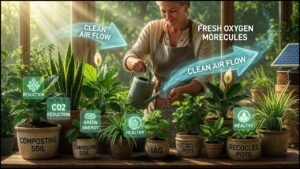
Air purifying plants are one of the most complete expressions of sustainable living available to the average household. They clean the air without consuming energy. They reduce dependence on synthetic chemicals. They support biodiversity and the broader ecosystem. They cost almost nothing to maintain. And they nourish the mental and emotional wellbeing of everyone who lives alongside them.
In a world full of sustainability choices that require sacrifice — spending more, consuming less, going without — houseplants are a rare and welcome exception. They ask very little and give back enormously.
If you’re building a more sustainable home and you haven’t yet thought seriously about the plants in it, now is the time to start. Not because it will solve everything. But because it’s one of the simplest, most beautiful, and most genuinely impactful steps you can take