
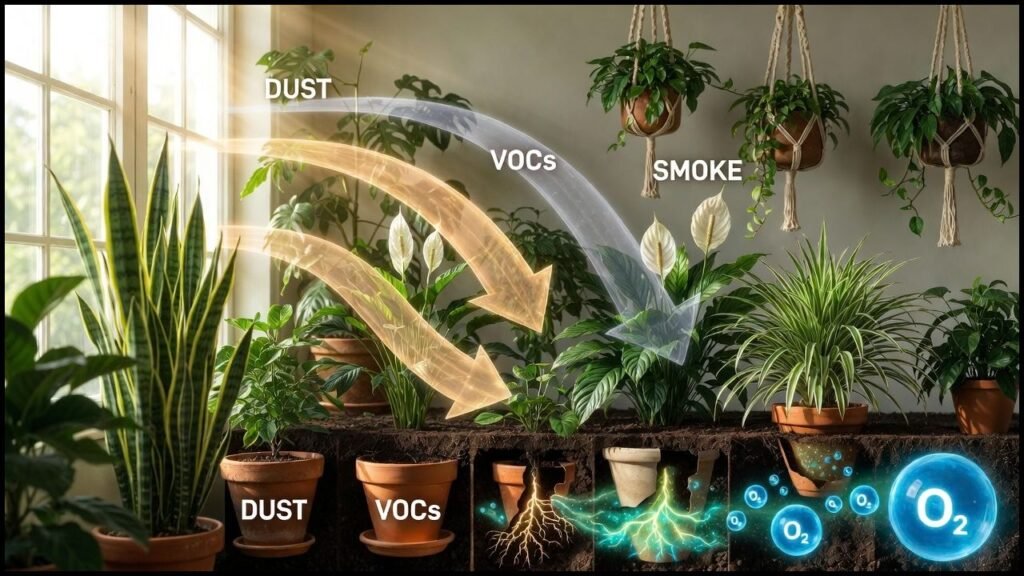
Take a deep breath, Now consider this — the air you just inhaled inside your home may be more polluted than the air outside on a busy city street. It sounds unlikely, but the EPA has consistently ranked indoor air pollution among the top five environmental health risks facing modern households.
The sources are everywhere and hiding in plain sight. Your sofa cushions. The fresh coat of paint on your walls. The cleaning products stored under your sink. Even the new carpet you just had installed. All of them silently release toxic chemical compounds into the air, day after day, in the space where you eat, sleep, and raise your family.
Most people respond to this problem by buying an air purifier or cracking a window. Both help. But there’s a third option that’s been sitting on garden center shelves all along — one that cleans your air, costs very little, and makes your home more beautiful in the process.
Air purifying plants.
Certain houseplants have a proven, science-backed ability to absorb indoor pollutants and neutralize them at a biological level. Understanding how they work — and which ones to choose — can meaningfully transform the air quality inside your home. Here’s everything you need to know.
What Is Indoor Pollution and Where Does It Come From?
Indoor pollution is primarily caused by a group of chemicals called volatile organic compounds, or VOCs. These are gases released by everyday household materials at room temperature — invisible, largely odorless, and consistently present in most modern homes.
The most common indoor pollutants include:
- Formaldehyde — emitted by pressed wood furniture, carpets, curtains, and certain cleaning products
- Benzene — found in paints, glues, solvents, and plastics
- Ammonia — present in household cleaning sprays, floor polishes, and fertilizers
- Trichloroethylene — released by adhesives, varnishes, and dry-cleaned clothing
- Carbon monoxide — produced by gas stoves, fireplaces, and poorly ventilated heating systems
- Xylene — off-gassed by paint thinners, printed materials, and synthetic fabrics
Individually, these compounds at low levels may cause nothing more than mild irritation. But in combination, and with prolonged daily exposure over months and years, they’re increasingly linked to chronic headaches, persistent fatigue, respiratory problems, and in serious cases, long-term organ damage.
The irony is that modern homes — better insulated and more airtight than ever — trap these pollutants more effectively than older, draftier buildings. The very energy efficiency we’ve engineered into our homes has inadvertently made the indoor air problem worse.
That’s where plants come in.
How Do Plants Actually Reduce Indoor Pollution?
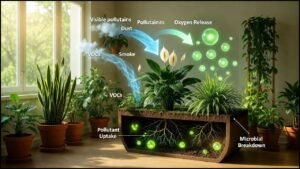
Plants don’t simply absorb pollution passively. They run an active, multi-layered biological process that works continuously to detect, capture, and neutralize airborne toxins. There are four key mechanisms at work.
Leaf absorption is the most direct. Every plant leaf is covered in microscopic pores called stomata that open during the day to take in carbon dioxide for photosynthesis. In the same breath, they pull in surrounding VOCs. Once inside the leaf, these compounds are either broken down through metabolic processes or transported to the root system for further neutralization. The larger the leaf, the greater the surface area — and the more air the plant can process.
Soil microbe activity is arguably the most powerful mechanism, and the most overlooked. A single pot of houseplant soil contains billions of microorganisms — bacteria and fungi that have co-evolved with plants over millions of years. When absorbed toxins travel down to the root zone, these microbes break them down into simple, harmless molecules. The plant and its soil community function as a single detoxification unit, and the health of that soil directly determines how effective the whole system is.
Transpiration creates a gentle but constant airflow. As plants draw water up from their roots and release it as vapor through their leaves, they pull nearby air toward their leaf surfaces — effectively increasing the volume of air that passes through their filtering system. This process also raises local humidity levels, which causes airborne dust particles and pathogens to become heavy enough to settle out of the air rather than staying suspended where they can be inhaled.
Root absorption handles what the leaves don’t catch. Certain VOCs are drawn in directly through the root zone alongside water and nutrients, where the roots themselves — and the surrounding microbial community — break them down. This is why plants in larger pots with more soil volume tend to be measurably more effective air purifiers than the same species cramped into a small container.
The Best Plants for Reducing Indoor Pollution
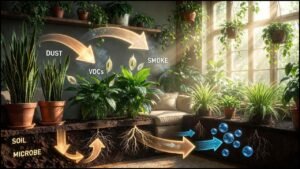
Research consistently highlights the following species as the most effective at targeting common indoor pollutants.
Snake Plant (Sansevieria trifasciata) — The most versatile air purifier on this list. It targets formaldehyde, benzene, xylene, and trichloroethylene, and is one of the few plants that produces oxygen at night rather than during the day — making it the single best choice for a bedroom. Nearly indestructible and thrives on neglect.
Peace Lily (Spathiphyllum) — One of the top performers in NASA’s original Clean Air Study. Peace lilies are unique in their ability to absorb ammonia and airborne mold spores — two pollutants most plants ignore entirely. Perfect for bathrooms, kitchens, and basements where mold and cleaning chemicals are most present.
Golden Pothos (Epipremnum aureum) — Consistently high-rated across multiple air filtration studies. Pothos removes benzene, formaldehyde, and carbon monoxide efficiently and adapts to virtually any lighting condition, from a bright south-facing window to a dim office corner.
Spider Plant (Chlorophytum comosum) — Particularly effective at absorbing carbon monoxide and formaldehyde. Non-toxic to pets, fast-growing, and almost impossible to kill. Place one near a gas stove or fireplace for the most targeted pollution reduction.
Boston Fern (Nephrolepis exaltata) — The best plant on this list for formaldehyde removal and humidity regulation. Boston ferns release more moisture through transpiration than almost any other common houseplant, making them exceptional in dry, centrally heated homes during winter.
Rubber Plant (Ficus elastica) — Its large, waxy leaves offer an enormous surface area for gas exchange, making it one of the most efficient single plants you can own for absorbing formaldehyde and airborne toxins. A statement piece that earns its space.
How to Get the Best Results
Choosing the right plants is only the beginning. These habits ensure they’re working at full capacity:
Clean the leaves regularly. Dust blocks the stomata that absorb pollutants. Wipe large leaves with a damp cloth monthly — it takes two minutes and makes a genuine difference to effectiveness.
Use healthy, nutrient-rich soil. Since the microbial community in the soil does the bulk of actual toxin neutralization, soil quality is one of the highest-impact variables. Refresh the top layer annually and use well-draining, biologically active potting mixes.
Size up the pot. More soil volume supports a larger, more diverse microbial population. When choosing between pot sizes, go bigger — particularly for plants in rooms where air quality matters most.
Don’t overwater. Waterlogged soil becomes oxygen-deprived, killing the beneficial microbes your plant depends on. Allow soil to dry slightly between waterings for most species.
Target specific rooms. Bedrooms and home offices — where you spend the most concentrated time — should be the priority. A snake plant in the bedroom and a pothos on the office desk is a simple, high-impact starting point.
Conclusion

Indoor pollution is a real and underappreciated problem — but it doesn’t require a dramatic solution. Air purifying plants reduce indoor pollution through a sophisticated biological process that works quietly, continuously, and without any running costs or maintenance beyond a little water and sunlight.
They won’t single-handedly solve a ventilation problem or replace a HEPA filter for allergy sufferers. But as part of a thoughtful approach to your home environment — alongside fresh air, low-VOC products, and good ventilation habits — the right plants in the right rooms make a meaningful, lasting difference to the air your family breathes every day, Start with a snake plant in your bedroom and a pothos in your office. Pay attention to how the spaces feel over the following weeks. Then keep going, Your home’s air is worth the investment. And few investments pay off as quietly, consistently, and beautifully as a well-chosen houseplant.